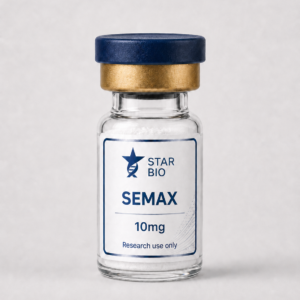
Semax has become increasingly recognised in recent years as one of the most intriguing nootropic-style compounds to emerge from Eastern European research.
Originally developed in Russia during the 1980s, Semax was created by scientists seeking a peptide that could influence memory, focus, and neurological resilience without the drawbacks associated with traditional stimulants. Over the following decades, it gained notable traction in Russian clinical and experimental settings, with various trials examining its potential effects on cognition, brain function, and recovery after neurological stress.
One of the main reasons Semax stands out is its origin within Russia’s long-standing interest in neuropeptide research. Russian laboratories became known for investigating short-chain peptides that interact with the brain’s regulatory systems.
In this environment, Semax was introduced as a heptapeptide analogue designed to influence specific neural pathways related to learning and recall. Unlike many nootropic agents, Semax does not function as an amphetamine or stimulant. Instead, research has often focused on how it may affect neurotrophic factors, neurotransmitter balance, and adaptive responses within the brain.
Across various Russian trials, Semax has been studied for its potential cognitive benefits, particularly around learning speed, attention, and memory formation. One frequently cited area of interest concerns memory recall. Early controlled observations in Russia suggested that subjects using Semax in structured tests showed improved accuracy in memory-based tasks, faster recall of learned material, and increased retention compared with baseline levels or placebo groups.
In some documented memory trials, Semax was noted to improve recall performance by margins ranging roughly from 20 to 40 percent, depending on the test format, duration, and the demographics of participants. While these figures vary between studies, they have contributed significantly to Semax’s reputation as a peptide with strong cognitive potential.
In addition to memory research, Semax has been examined for its broader neurological influences. Russian studies have considered how the peptide interacts with the brain during periods of stress, fatigue, or cognitive overload. Investigators observed that Semax appeared to support more stable concentration levels and a more efficient cognitive response under pressure.
This led to its use in certain Russian clinical contexts, ranging from cognitive fatigue to demanding professional environments where mental clarity is essential.
Outside Russia, interest in Semax has grown steadily as more researchers look to explore neuropeptide mechanisms. Its structure, stability, and unique mode of action continue to attract attention from those studying cognitive enhancement, neuroplasticity, and brain chemistry. Although much of the published work originates from Russian research institutions, the global scientific community has increasingly acknowledged Semax as a noteworthy peptide deserving further study.
Today, Semax is widely discussed for its potential role in mental clarity, memory performance, and cognitive function. While more international trials would strengthen the understanding around its mechanisms and long-term outcomes, existing Russian data provide a strong foundation for ongoing interest.
In summary, Semax represents decades of focused neuropeptide research, supported by extensive Russian testing and compelling memory recall data. Its reputation as a cognitive enhancer continues to grow, making it a leading subject of interest for modern researchers exploring advanced nootropic pathways