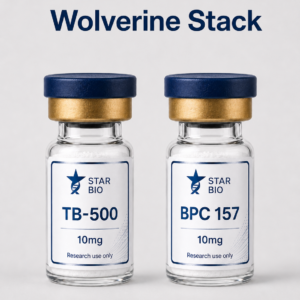
The “Wolverine” Peptide Stack: Exploring Tissue Repair Pathways
Researchers have taken interest in combinations of peptides that appear to complement one another in models of tissue recovery. One such pairing, often called the “Wolverine stack,” brings together BPC-157 and TB-500 (thymosin beta-4 fragment). Each works through distinct biological pathways, and together they create an informative model for studying how tissue repair and recovery might be optimised under controlled laboratory conditions.
BPC-157
BPC-157 is a synthetic fragment of a natural protective protein found in gastric juice. In research models, it has been linked with support for angiogenesis (new blood vessel growth), modulation of inflammatory pathways, and enhanced healing of muscle, tendon, and gut tissue. Rodent and in vitro studies consistently show faster repair responses compared with controls (Sikiric et al., 2018). While published human data are limited, preclinical findings make it an intriguing tool for laboratory studies of musculoskeletal healing and tissue resilience.
TB-500
TB-500 is a shortened version of thymosin beta-4, a naturally occurring protein involved in cell migration and tissue remodelling. The active peptide region promotes actin polymerisation, which supports cell movement into sites of injury. Animal and early-stage research suggest roles in reducing inflammation and accelerating healing of skin, muscle, and cardiovascular tissue (Goldstein et al., 2012). Because TB-500 is a simplified fragment, it allows researchers to focus specifically on repair-related pathways without the full range of thymosin beta-4’s functions.
Why the pair is synergistic
BPC-157 and TB-500 act through different mechanisms. BPC-157 seems to support local repair by promoting vascular growth and modulating inflammation. TB-500, by contrast, enhances the ability of cells to migrate and reorganise the cytoskeleton, which is vital for rebuilding tissue. Together, the two peptides may offer a complementary perspective: one supporting the environment for healing, the other helping the cells move into place. While head-to-head human trials are scarce, animal studies suggest that pairing angiogenic and cytoskeletal pathways produces more robust repair than targeting either alone (Sikiric et al., 2018; Goldstein et al., 2012).
Off-season recovery and muscle building
For athletes in the off-season, research interest often shifts from peak performance to recovery and long-term resilience. GH-boosting agents are sometimes discussed in this context, but the Wolverine stack provides a different angle: modelling accelerated repair and reduced downtime between training cycles.
Preclinical data suggest benefits for tendon integrity, muscle recovery, and possibly joint health. Human-controlled trials are limited, so strength and performance outcomes remain speculative. The most consistent observation across animal models is reduced healing time and improved tissue structure, rather than direct gains in power or speed.
Anecdotal evidence
Beyond the published studies, anecdotal reports from research communities are noteworthy. These often describe shorter recovery times, reduced soreness, improved joint comfort, and a perception of faster return to training capacity. Although such accounts cannot substitute for controlled clinical data, they provide context for why researchers are interested in further exploring this stack.
Animal findings also suggest a potential mechanism for these reports. In rat models, BPC-157 has been shown to increase the density of androgen receptors in muscle tissue after injury (Tkalčević et al., 2007). If this translates to humans, it could mean greater responsiveness to anabolic signals, though this remains speculative.
Women
Women can be studied in the same way as men. The core mechanisms—angiogenesis, inflammation control, and cytoskeletal remodelling—are not sex-specific. Oestrogen can influence repair capacity, particularly in connective tissue. For robust data, researchers should record menstrual cycle phase or menopausal status, as these may affect baseline healing rates.
Practical notes for researchers
Keep BPC-157 and TB-500 in separate, clearly labelled vials. Their research targets differ, and fixed-ratio mixes do not allow accurate study design.
Record training load, diet, and sex hormone status to reduce confounding variables.
Compliance note
Neither BPC-157 nor TB-500 is approved for human therapeutic use. Data in humans are limited and exploratory. This article is for laboratory research purposes only. It is not medical advice, and the compounds are not for human consumption.
References
Sikiric P et al. “Stable gastric pentadecapeptide BPC 157: Novel therapy in gastrointestinal tract and beyond.” Curr Pharm Des. 2018;24(18):1916–1935. https://pubmed.ncbi.nlm.nih.gov/29708066
Goldstein AL, Hannappel E, Sosne G. “Thymosin beta-4: a multi-functional regenerative peptide.” Basic Sci Cancer Med. 2012;7(2):133–144. https://pubmed.ncbi.nlm.nih.gov/22577536
Tkalčević VI et al. “Peptide BPC 157 enhances the expression of the growth hormone receptor and androgen receptor in rat muscle tissue after injury.” J Physiol Res. 2007;56(5):541–550. https://pubmed.ncbi.nlm.nih.gov/18063869
-
Uncategorized
Wolverine Stack. One month’s Supply. 2 X TB500, 1 X BPC157 Bundle
Original price was: £104.99.£94.99Current price is: £94.99. Add to cart